Seaweed sustains Southeast Asian livelihoods—and the world
When we look at our future, it’s hard to imagine a world where most of us can continue living the way we do without further harming our planet in return. Almost all of our choices and actions seem to be hurting the environment—whether it’s worsening climate change, degrading our land by pumping it with synthetic fertilisers to squeeze out more crops, or destroying our oceans with plastics and microplastic pollution.
But what if there was a more sustainable solution? One that had the potential to not only minimize our negative impact, but also help to restore the balance between people and our planet?
For this, we look to one part of the world that is moving closer to realizing that solution: the coastal folks of Southeast Asia (SEA) who, in times of economic struggle, have found resilience in seaweed cultivation. And more of them are farming seaweed sustainably.
Asia contributes to nearly all—98–99 percent—of the world’s seaweed production. Of that amount, SEA produces nearly a third, among which Indonesia and the Philippines lead as the top global producers alongside China.
Yet the region, where over 70 percent of its 700 million-odd population live in coastal areas, did not always turn to seaweed. Seaweed farming was introduced to SEA in the 1970s to meet surging global demand for carrageenan, an ingredient extracted from seaweed with natural thickening and gelling properties, now found in everyday products like ice cream, lotions, and medicines. Before that, production of carrageenan was restricted by availability of natural stocks of Chondrus crispus (also known as Irish moss) from the Atlantic waters of Canada and Europe, and Gigartina from South America and Southern Europe.
Today, seaweed offers a sustainable livelihood for thousands of coastal communities and their future generations across SEA.
“The sea is our source of living”
—Asteria Torion, a seaweed farmer in the Philippines
in an interview with the Earthshot Prize, a global environmental award which finds and scales bold, innovative solutions for our planet.
Asteria Torion makes a living as a seaweed farmer on Mahanay Island, in the Danajon Bank region, the Philippines’ only double barrier reef. She farms seaweed as a partner of Coast 4C, a local startup building coastal livelihoods and resilience through seaweed.
In the Philippines alone, the seaweed industry supports more than 1 million farmers. “Before I got involved in seaweed farming, we couldn’t send our children to school because we had no income,” Torion, a mother of seven, said.
To learn more about the experiences of seaweed farmers, click below to read stories from Seaweed Connect, a platform that works to chronicle and amplify stories of seaweed farmers, and foster collaboration in the seaweed industry.
Map of seaweed production sites in Southeast Asia
Today, coastal communities in Southeast Asia contribute to nearly a third of the world's seaweed production. The tropical seaweed they farm is used in many industries around the world, such as food, aquaculture feed, pharmaceuticals, cosmetics, and more.
The main applications for tropical seaweed remain carrageenan (primarily from Kappaphycus and Euchema seaweeds) and agar (primarily Gracilaria). Used as a thickener, stabilizer, and emulsifier in the food, cosmetic, and pharmaceutical industries, carrageenan is important for its ability to bind with proteins and prevent ingredients from separating, e.g, cocoa from settling in chocolate milk, and thickening plant-based milks.

Click on the circles to explore the map.
Newer seaweed applications and what they are used for
Why is seaweed such an important source of income for coastal communities in developing economies, from Southeast Asia (SEA) to Africa?
Seaweed farming diversifies the sources of income for these traditional fisherfolk, reducing the impact of human activities such as overfishing on local animal species. It also sustains not just their livelihoods, but all other parts of the world as well through indirectly boosting our food supply, climate resilience, and ocean biodiversity.
Because it grows quickly in the ocean without needing freshwater, fertilizers, or farmland, seaweed has potential for many different applications in some of the world’s biggest industries.

Agricultural inputs
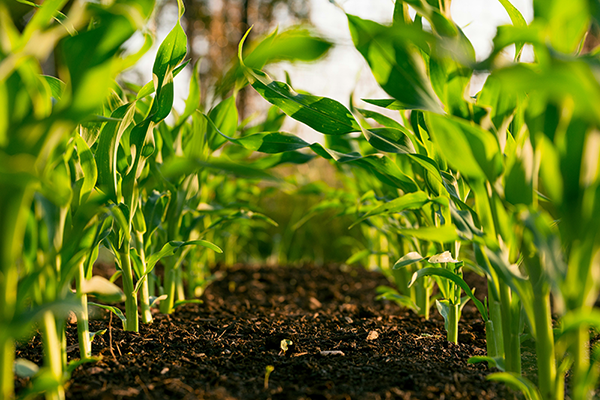
For the past century, industrial fertilizers have increased our crop yields, allowing our agricultural system to rapidly produce food for the world’s growing population. However, as a consequence of long-term use, synthetic fertilizers degrade our soil’s health over time by reducing microbial diversity and disrupting natural soil structure.
A new and fast-growing seaweed product is biostimulants for agriculture, which boost nutrients uptake and tolerance to environmental stresses (drought, extreme temperatures and salinity) as well as stimulate plants’ own stress defense compounds and metabolism. All this reflects the regenerative properties of seaweed.
Biostimulants are rising in popularity because they also reduce the use of contaminating industrial fertilizers, serving as an environmentally friendly and sustainable option that boosts crop yields and resilience, while restoring soil health and benefits. This way, farming can sustainably produce more nutritious food. Crops grow better, and deliver better-quality produce that show in their healthier, improved visual appearance, nutritional quality, and size/flavor.To a lesser extent, seaweed is also used as an animal feed ingredient in SEA, though interest is growing rapidly. Seaweed meals and extracts are increasingly being used as functional feed additives for shrimp, fish, poultry, and ruminants due to their potential benefits for animal health, immunity, and feed efficiency. This is particularly as the livestock and aquaculture sectors seek more sustainable and climate-friendly feed solutions.
Bioplastics and Biomaterials
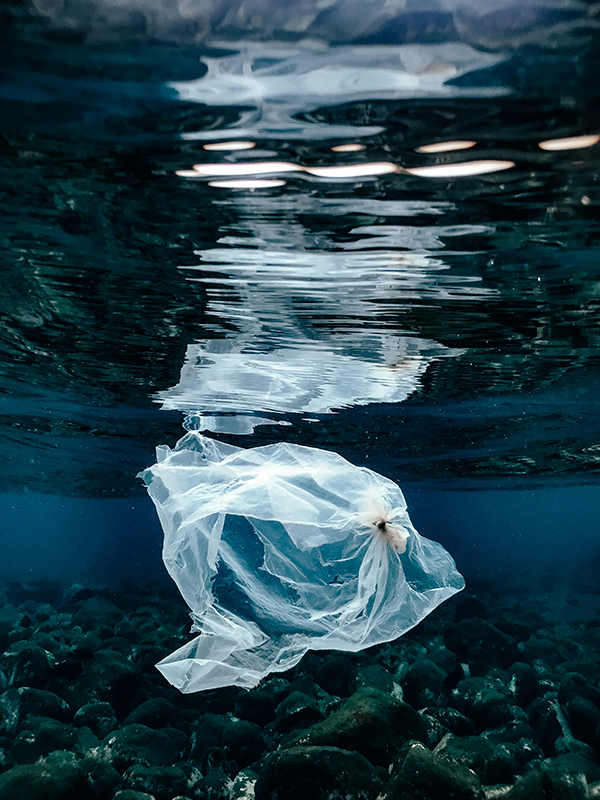
Conventional plastics are nonbiodegradable, polluting our oceans with chemicals and microplastics, choking or hurting fish, turtles and other marine life, and disrupting marine ecosystems for years after being discarded. Plastic removal initiatives help to reduce our pollution, but only address the problem after it has already happened. To address all parts of the system, we need a solution further upstream—a biodegradable alternative that breaks down into its natural components.
Seaweed possesses compounds, such as alginate, carrageenan, and agar, that can be converted into biodegradable films, coatings, and bioplastics. Seaweed-based bioplastics are increasingly being explored for food packaging, single-use containers, edible wraps, and other eco-friendly alternatives that help reduce plastic pollution in both land and marine ecosystems by breaking down naturally over time once it is in the ocean. And since seaweed grows abundantly in the ocean, it does not compete with food crops for land, unlike other bioplastics made from corn or sugarcane, for example.
While the field is still relatively new, with its transition from lab to industrial scale, seaweed bioplastics have potential to be a sustainable, economic alternative to conventional plastics. Other seaweed-based biomaterials are also being explored for use in textiles, cosmetics, pharmaceuticals, and construction products.
Ocean Regeneration
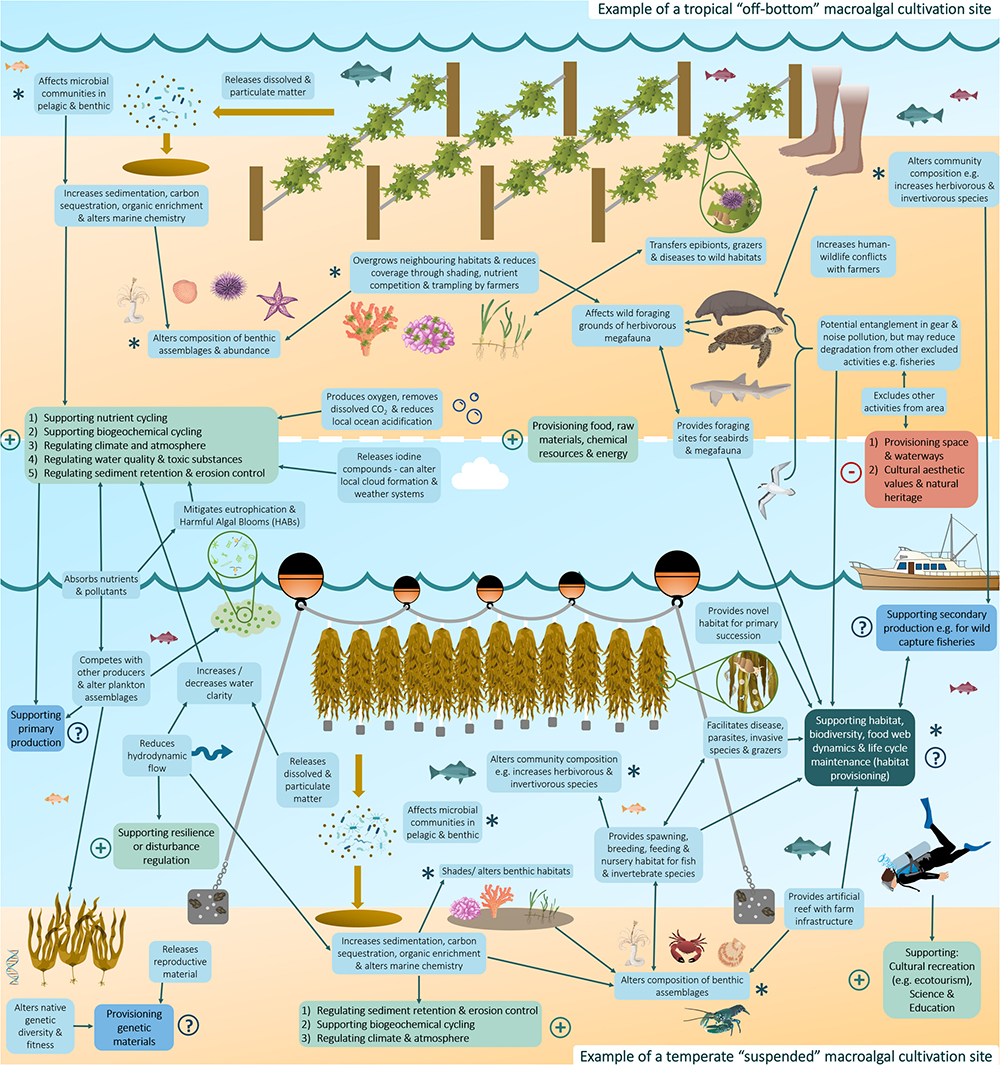
An example of a tropical macroalgal cultivation site (top half) and a temperate macroalgal (i.e. kelp) cultivation site (bottom half). Seaweed’s regenerative properties allow it to contribute to the biodiversity and health of the ocean ecosystem as it grows. Graphic by The Integration and Application Network, University of Maryland Centre for Environmental Science (http://ian.umces.edu/imagelibrary/) and BioRender (Biorender.com) As seaweeds grow, they absorb large amounts of carbon. Seaweed farms are therefore highly efficient at removing atmospheric CO₂ because seaweed grows rapidly and converts carbon into biomass.
As the seaweed grows, it constantly sheds parts of its fronds and tissue as particulate organic matter (detritus). Some of that biomass, which contains carbon, gets buried in marine sediments below. The rest gets exported into the ocean as drifting particles and dissolved compounds.
Seaweed also promotes biodiversity by improving water quality and reducing pollution, as it absorbs excess nutrients like nitrogen and phosphorus from the water that negatively impact the growth of ocean life. This contributes to a healthier ocean environment for seaweed to grow in, creating a cycle in which it gives to the ocean, and the ocean gives back to it—allowing the crop to flourish.
Why focus on seaweed in Southeast Asia?
As a leading global producer of seaweed, Southeast Asia (SEA) has massive scaling potential, thanks to the region’s tropical climates enabling harvest cycles of 45 days and extensive coastlines spanning 170,000–180,000 kilometers.
Taking a leaf from Europe and North America, SEA has embraced disruptive technologies and business models in the past several years, attracted by the prospects of moving up the seaweed value chain.
Until recently, the region, with smallholder farmers as its backbone, had been limited to trading dried seaweed biomass in the commodity segment—as price takers vulnerable to market price volatilities. The carrageenan market they sell to is one tightly controlled by big players and subject to middlemen taking cuts and capping their earnings.
Yet, at the same time, the farmers themselves are the biggest risk-takers in the value chain, due to their foundational role in the market structure, lack of capacity to invest, and lack of technical know-how.
Grasping these issues—and the opportunities therein—entrepreneurs and governments (both local and national) have begun leveraging the seaweed industry. They exploit innovations in technology and business models to expand to new markets, such as agricultural inputs and biomaterials, while the government builds a supportive supply chain infrastructure for businesses to thrive and expand.
In this, international impact investors and nonprofit organisations such as Conservation International, Katapult Ocean, Potato Impact Partners and the Global Seaweed Coalition have been a key supporting force, providing grants and catalytic capital for such projects to test out their market offerings, finetune and derisk, as well as enable market building and developing the relevant tracking, management and reporting systems and processes in the companies’ early years.
Meanwhile, the valuations of seaweed startups in SEA remain relatively capped, compared with their more famous peers in the West that have been lifted by investor enthusiasm for ocean and climate opportunities. Local labor costs are also lower, giving companies greater room to expand. These factors have led to rising investor interest—especially from Asia-based impact investors and their respective ecosystems.

What problems are SEA seaweed startups solving?
Smallholder farmers in SEA face challenges in the seaweed cultivation process, mainly the lack of quality seedlings, hindering their work:

Rapid climate change warming waters in their seaweed farms, which stresses the seaweed and hurts yields.
Lack of quality, more resilient seedlings to address the above.
Delays and shortages in supply, and increased expenses caused by
supply chain inefficiencies, given their limited access to technology.
As individual producers with small quantities, SEA smallholder seaweed farmers are limited to selling in lower-value markets, mainly in carrageenan trading. In the selling process, high negotiating and contracting costs leads buyers to favor higher- volume producers, which puts smallholder farmers at a disadvantage.
Additionally, to sell to buyers, smallholder seaweed farmers need traders in the middle who provide input materials, such as seedlings; logistics management; and access to the market that the farmers do not have. While this arrangement guarantees that they have buyers, smallholder farmers are often exploited by these middlemen who have the power to set the pricing of their seaweed, controlling the distribution of profits and leaving farmers in a cycle of debt that their resources cannot keep up with.
As a result of these factors, while production is still high, seaweed production growth in SEA has stalled since the 1990s.
What solutions are startups providing?
To address smallholder farmers’ plateauing production growth rates, innovations in seaweed cultivation technology can bolster crop tolerance to environmental stressors such as warming waters, while helping SEA seaweed farmers adapt to the impacts of climate change.
Examples include:
Developing new seaweed strains that are more resilient to effects of climate change
Hatcheries that focus on efficient and sustainable production of high-quality seaweed seedstock for cultivation, utilizing techniques like sporulation, micropropagation, and breeding to ensure better quality and yield
Monitoring tech to track and anticipate water conditions that are not conducive to seaweed growth, allowing seaweed farmers to adapt accordingly
Processing technologies that turn farmed seaweed into higher value products, such as biostimulants, than the current carrageenan sold as principal seaweed commodity.
Southeast Asia seaweed + tech = The New Green
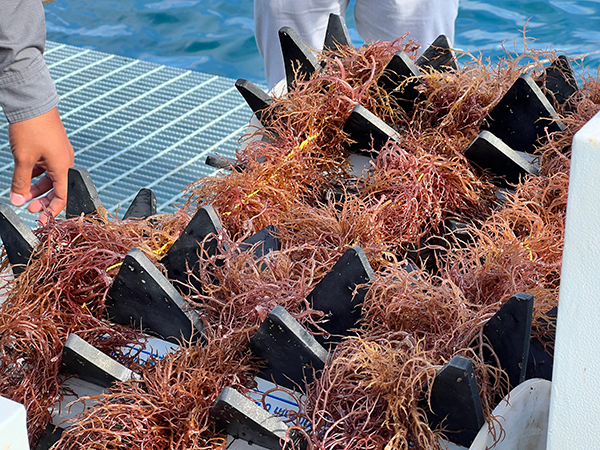
Red seaweed being harvested by Sea6 Energy, a deeptech company with operations in Lombok, Indonesia, advancing innovations in large-scale, mechanized seaweed farming, processing and product development.
Seaweed’s newer market applications in agriculture, eco-friendly packaging and more have launched a new generation of startups in Southeast Asia (SEA). Local entrepreneurs also see clearly how a strong seaweed economy could improve the livelihoods of smallholder farmers—both those who farm seaweed, and others using seaweed biostimulants to improve crop yields.
Attracted by such opportunities, some investors began supporting seaweed technological innovations as well. BASF Venture Capital, the venture investment arm of agrochemicals giant BASF, and Aqua-Spark led the wave in 2022, leading a $18.5 million investment round in India-based Sea6 Energy to support its mechanized large-scale seaweed farming expansion in Indonesia.
Subsequent local seaweed deals have been much smaller, however, and slow to follow. In 2025, Malaysia-based SEADLING raised $1 million, while in Indonesia, BANYU raised $1.25 million and Zentide secured $525,000.
In contrast, the cooler climes of Europe and North America have dominated investments. Strong state mandates to build seaweed into a new growth engine for sustainable development have been instrumental in providing the early funding to derisk investments and support R&D in cultivation and processing that expand the reach of seaweed to bigger and higher-value markets.
For example, the European Union (EU) has been investing heavily in research, generous subsidies, and ambitious R&D and cross-sector, pan-EU collaboration programs for the seaweed bioeconomy. The targets to produce 8 million tons of farmed seaweed by 2030, valued at 9 billion euros, and potentially creating 85,000 jobs.
The EU-wide programme to develop a seaweed industry has helped catapult European seaweed startups to the forefront of technological innovation in sustainable seaweed cultivation, processing, and the development of higher-value applications, such as biostimulants, bioplastics and other biomaterials, and nutraceuticals. Today the continent has about 480 seaweed companies, most of them startups, growing over 15% yearly. Alongside a fast-expanding seaweed tech ecosystem, investment funding into European seaweed startups has also followed.
The same conditions have not manifested in SEA. Although the region produces nearly half of the world’s seaweed in volume terms, local companies, together with others producing tropical seaweed, received only 5% of the sector’s global equity investments, according to data shared by the Global Seaweed Coalition in 2025.
Compare that with Europe, which accounts for less than 1% of global seaweed production, or about 287,033 tons in 2019, according to latest available data. Of that total production, 4% came from farmed seaweed. Most of Europe’s seaweed comes from wild harvesting, that is, collected directly from the natural ocean environment.
For growth and impact, invest in Southeast Asia seaweed
Now it is ripe for diversification into Southeast Asia seaweed. Not only does the region have the immense biomass volumes ready for scaling into higher-value applications—at lower prices, too—local entrepreneurs are also generating a pipeline of multi-industry, multi-impact opportunities.
Inspired by the potential of seaweed to improve incomes, livelihoods and environmental outcomes for coastal communities in Indonesia, Vietnam, the Philippines and Malaysia, a growing number of seaweed startups have emerged. They are leading the charge using the technological upgrades already seen in Europe and North America, so they could farm seaweed sustainably and reliably. They usually do so in partnerships with local smallholder farmers, equipping them with improved quality seedlings and farming techniques for resilience against climate change.
Armed with a secure supply of quality biomass, these startups scale local seaweed to leverage higher-value markets, converting the resource into biostimulants for local land farming, pet food and animal feed for local aquaculture. This in turn enables the next generation of higher-value applications, e.g., nutraceuticals, bioplastics, textiles, to become cost-competitive while enjoying good margins—all lifting local seaweed along.
As a result of the current energy and food inflation crises, SEA’s economies—most of them major net oil importers—have never been harder hit. And so environmentally positive, and cheaper, alternatives to petroleum-based fertilisers, plastics and fuels, seaweed-based applications have never been more relevant.